- FREE SHIPPING on all orders over $149.99
The accuracy of your results depends largely on the quality of the samples you use in your study. Peptides are very fragile biological substances whose stability depends on proper handling and storage.
While concentrating exclusively on the quality and purity of the substance during procurement, which should certainly be one’s priority, we mustn’t overlook the other aspect that may seriously affect the quality of the sample. Even the purest research-grade peptide can lose its stability due to improper storage conditions. It is crucial to learn proper storage techniques to achieve reliable results.
This guide walks through the best practices for storing research peptides from the moment they arrive at your laboratory to the point of use.
A peptide refers to a string of amino acids bonded by peptide bonds. Even though it is relatively stable compared to proteins, there are various ways in which peptides can be degraded, including oxidation, hydrolysis, aggregation, and contamination by microorganisms. These processes change the composition of the peptides in such a way that they lose their bioactivity.
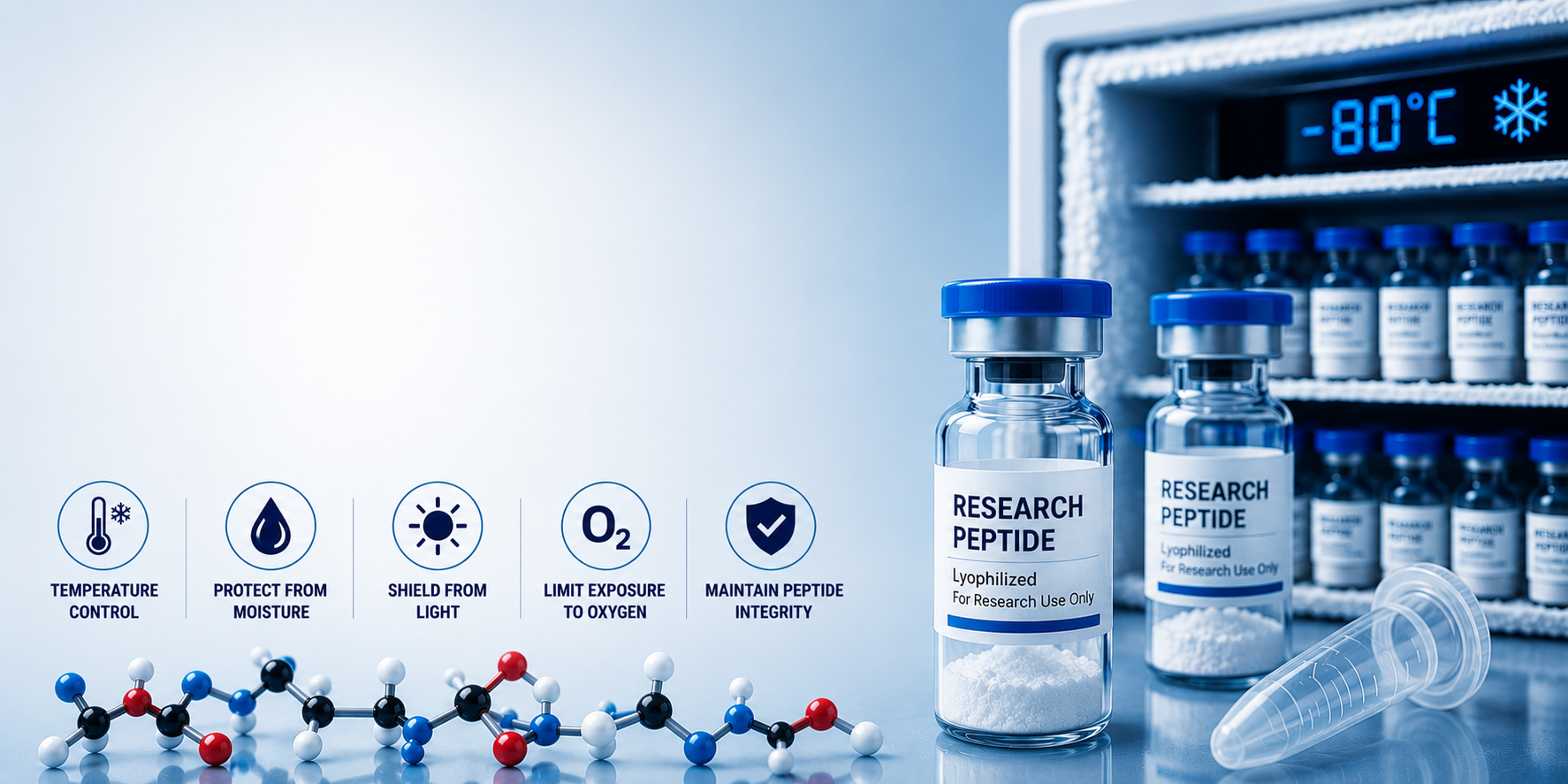
In storing peptides, there are five major factors that have to be controlled: temperature, moisture, light, oxygen content, and pH. The success with which these factors are controlled will determine the ability of the peptides to maintain their stability throughout the required period.
It is wise and economically prudent to use the right storage procedures for peptides from the very start of experimentation since peptides used in research are relatively expensive.
Another decision that must be made early on is the type of peptide storage format. Commercially purchased peptides come in one of two formats: freeze-dried or already dissolved in solution. The methods of storage for these two formats vary greatly from one another.
Freeze-dried peptides are much more stable. In their freeze-dried state, peptides are able to be stored at -20° for up to a year or two without any major deterioration. For this reason, freezedrying is preferred when long-term storage is required.
Peptide solutions, on the other hand, are far more sensitive and susceptible to degradation. When peptides are dissolved in solution, they are susceptible to hydrolysis and contamination. Reconstituted solutions need to be used relatively quickly or stored frozen (-80°).
In summary: it is recommended that you store your peptides in a freeze-dried state for as long as possible. Only prepare what you need in the moment.
Temperature is a critical component of all proper peptide storage methods. High temperatures contribute to the chemical breakdown of peptides, cause aggregation, and ultimately shorten the peptide shelf life. Ensuring proper temperature during storage should not be negotiable.
The following temperature ranges serve as guidelines for proper peptide storage:
Up to 25°C: Only viable for stable peptides in the short term – days only.
2° to 8°C: Suitable for lyophilized peptides only for several weeks.
-20°C: Most appropriate for storage of most lyophilized peptides from six months to up to two years.
-80°C: Best option for reconstituted solutions and highly sensitive substances.
Aside from temperature, consistency is equally important. Any fluctuations in the storage environment, even within the recommended range, might result in accumulation of stress for the peptides. Multiple freeze/thaw cycles have particularly devastating effects since they contribute to the crystallization process, breaking up peptide structures. We’ll discuss this in more detail later on.
A relatively small degree of humidity is sufficient for triggering hydrolysis of lyophilized peptides – especially if they tend to be hygroscopic and easily absorb moisture from the surrounding air. This method of compromising the structure of peptides is particularly dangerous, since it acts in an insidious way without any obvious signs.
There are several peptides preservation methods from moisture:
Peptide storage in sealed glass vials with moisture absorbers, e.g. silica gel.
Avoiding removal of a cold vial right out of the freezer – allow time to adapt to room temperature while still in a sealed state to prevent formation of condensate.
Operating in conditions of low humidity as often as possible.
Sealing the vials and returning them to storage right after usage.
The last advice is probably one of the most disregarded tips of correct peptide storage. Opening a cold vial in a warmer room causes condensation to form on its colder interior surfaces – and right on top of the peptide samples.
Peptides with methionine, tryptophan, or cysteine side chains are highly prone to oxidative modification. When exposed to light and oxygen, the reaction can modify these amino acid residues in such a manner as to impact their biological activity without your initial knowledge but guaranteed to influence your experimental outcome.
As a means of minimizing oxidative degradation during the peptide storage process:
Store peptides in amber or opaque vials to prevent the action of UV radiation and visible light on the sample.
Evacuate headspace of the storage vials using nitrogen or argon gas before closing the lid.
Do not store peptides in vials having a considerable airspace.
Ensure that the solvent used for dissolving the peptides has been degassed or evacuated from nitrogen gas.
It is especially important when dealing with long-term peptide storage or sensitive analyses, since any change in the peptide structure can result in erroneous outcomes.
One of the more scientific decisions when it comes to storing peptides in solution is selecting the appropriate solvent. The wrong solvent can prove to be quite detrimental, so it’s important to get it right based on the chemical structure of your peptide.
Guidelines:
Acidic Peptides – dissolve in a basic solution like dilute ammonium bicarbonate or ammonium hydroxide.
Basic Peptides – dissolve in dilute acetic acid (0.1%) or sterile water.
Hydrophobic Peptides – may need organic cosolvents like acetonitrile or DMSO, followed by diluting with an aqueous solvent.
Neutral Peptides – usually dissolve easily in sterile water or phosphate buffered saline.
Failure to select an appropriate solvent could lead to aggregation, precipitation, and even premature degradation of the peptide.
One of the most critical habits that you can form regarding the best practices for storing research peptides is to aliquot your stock in portions that will be used in one experiment only and never use the same vial again after thawing.
Each freezing and defrosting causes stress to the molecule in terms of crystallization, temperature shock, and gradual deterioration. With every third, fourth, or fifth defrost, the damage accumulates to a degree that reduces the concentration and effectiveness of your peptide considerably. If you paid good money for your peptide or there was difficulty obtaining it, then you need to protect it.
You should aliquot your stock in the volumes that you will need for the experiment. The labeling of all vials with all information related to the peptide and preparation is mandatory.
Peptide storage is not just about proper conditions; it also involves documentation of every step of the process. In an efficient lab setting, there should be paperwork for each peptide, including its arrival date, the lot number, and the purity certificate. It is also important to document the date on which the peptide was reconstituted, what solvent was used, and the exact concentration.
Other forms of documentation that are important include:
Number of freeze-thaw cycles the peptide has experienced.
Use of a freezer monitoring system that will notify you of any changes in temperature within the freezer.
Knowing the exact storage history of the peptide makes it possible to tell whether a particular stored peptide can still be used for research. If it cannot be used anymore, the shelf life will provide no useful information whatsoever.
Regardless of optimal conditions, all peptides will ultimately reach the end of their useful life span. It is part of good lab technique to know when to discard a sample because it no longer has any validity.
Indicators worth noting include:
Formation of visible precipitates or cloudiness in a sample solution.
Change in color from what the solution looked like originally.
Uncharacteristic findings in bioassays compared with baseline findings.
Purity measurements taken using HPLC differ from what is on the original analysis certificate.
When in doubt, test the sample again prior to use in experiments. Lyophilized peptides can be kept at -20°C for one to two years, but other factors can shorten this peptide shelf life
Closing Comments
All of your hard work involved in peptide storage will be rewarded each time you conduct your experiments. When you handle your samples in the right way, you get results you can be certain about. If not, you risk adding confusion when you least need it.
Use this guide to best practices for storing research peptides, establish positive habits now, and take care of your peptides like they were one of the most important parts of your research. They certainly are.
